The Word Count Myth
"Write 2,000+ words to rank" is one of the most stubborn myths in SEO. Google has no word-count threshold. It ranks pages by how well they satisfy the intent behind a query — and a tight 500-word page that answers the question directly will beat a 3,000-word page that buries the answer under padding.
The confusion comes from a correlation. Comprehensive pages often happen to be longer, so people assume length caused the ranking. It didn't — the depth did, and length was a side effect. Chase the depth and the right length takes care of itself.
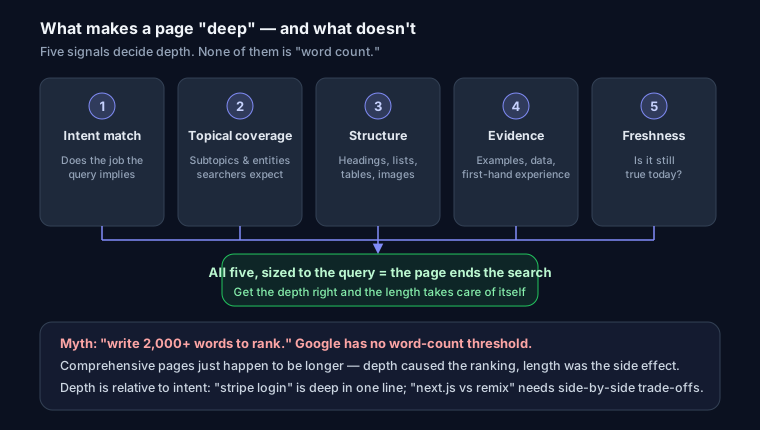
What "Depth" Actually Means
Depth is not thickness. A page is deep when it fully satisfies the searcher's intent and covers the subtopics and entities a person expects to find — the questions they'd ask next, the related terms, the comparisons, the caveats. That's topical coverage. A thin page leaves you opening a second tab to finish the job; a deep page ends the search.
Concretely, depth is a combination of:
- Intent match — does the page do the specific job the query implies?
- Topical coverage — does it cover the subtopics and entities a searcher expects?
- Structural quality — headings, lists, tables, images that make it usable
- Supporting evidence — examples, original data, screenshots, first-hand experience
- Freshness — is the information still true today?
None of those is "hit 1,500 words."
Match Depth to Intent
Depth is relative to the query. The single biggest mistake is applying "long-form" to a query that wants a one-line answer.
| Query type | Example | What "deep" looks like |
|---|---|---|
| Quick answer | "what time is it in Tokyo" | One sentence, instantly |
| Transactional | "buy running shoes size 10" | Fast product grid, specs, price — not an essay |
| Navigational | "stripe login" | The link, immediately |
| Guide / how-to | "how to fix render-blocking CSS" | Full walkthrough, edge cases, code |
| Comparison | "next.js vs remix" | Side-by-side tables, trade-offs, use cases |
Padding a transactional page with 1,500 words of history hurts it — you push the thing the user came for below the fold. Depth on a "best" or "how-to" query means breadth: covering the angles competitors miss. Read the SERP before you write. If the top results are 400-word answers, a 2,000-word wall is the wrong instinct.
Finding the Subtopics to Cover
You can't cover what you haven't mapped. Four cheap sources tell you what a searcher expects:
- People Also Ask — expand a few and they branch into more. Each is a real subtopic (often a good H2 or FAQ entry).
- Related searches — the block at the bottom of the SERP shows adjacent queries and entities to touch on.
- Competing pages' headings — pull up the top 3-5 results and read only their H2/H3s. The union of their subheadings is your coverage checklist. If four of five cover "cost" and you don't, that's a gap.
- Questions real users ask — support tickets, Reddit threads, sales calls. These surface the edge cases no competitor addressed, which is where you win.
Turn that map into an outline before writing a word. If a subtopic doesn't serve the intent, cut it — coverage isn't a license to ramble.
Depth vs Word Count, Side by Side
| Metric | Good content | Bad content |
|---|---|---|
| Word count | Whatever the intent needs | 300 (thin) OR 5,000 (padded) |
| H2 headings | 4-6 covering real subtopics | 0-1 (wall of text) |
| Lists / tables | Summarize and compare | Everything buried in prose |
| Images | Original screenshots, diagrams | Stock photos or none |
| FAQ | Answers questions people ask | Invented filler questions |
| Evidence | First-hand data, examples | Generic restated definitions |
Diminishing Returns and the "AI Wall of Text"
Every extra paragraph past "the intent is satisfied" adds risk, not value. Padding dilutes relevance, pushes key info down, and signals to a reader that you're stretching.
This is exactly what Google's Helpful Content system targets: content that exists to rank rather than to help. A common failure mode now is the mass-produced "AI wall of text" — long, fluent, structurally fine, and empty. It restates the query five ways with no first-hand insight and cites nothing you couldn't get from the first result. That pattern gets flagged as unhelpful, and site-wide it can drag down pages that were good. The fix isn't more words — it's more substance per word.
Structure Is a Depth Signal
Two pages with identical facts aren't equally deep if one is scannable and one is a slab. Structure is how depth becomes usable:
- Scannable H2/H3 that mirror the subtopics you mapped — a reader (and a crawler) should get the outline from the headings alone. See the H1-H6 heading hierarchy guide for getting the levels right.
- Tables and lists for anything comparative or sequential.
- Original assets — your own screenshots, a chart from your own data, a real code sample. This is also an experience signal: it proves first-hand knowledge, which is the added "E" in E-E-A-T. Stock photos prove nothing.
- Real examples over abstract definitions.
When a page earns an FAQ or how-to section, marking it up with JSON-LD tells Google exactly what those blocks are — spin one up with the schema generator. It won't add depth on its own, but it makes the depth you have machine-readable.
Add Depth Without Padding
A practical loop that adds substance, not filler:
- Map intent + subtopics from PAA, related searches, and competitor headings.
- Answer the core query in the first screen. Don't make people scroll for it.
- Add one thing competitors don't have — original data, a screenshot, a gotcha you hit in production.
- Convert prose to tables/lists wherever you're comparing or listing.
- Cut every sentence that doesn't add information. If deleting it loses nothing, it was padding.
- Link to the deeper resource instead of re-explaining it inline.
That last point matters for site architecture. Don't stretch one page to cover five distinct intents; split them across focused pages and interlink. And if you've created several thin pages competing for the same query, consolidate — that's keyword cannibalization, and one deep page usually beats three shallow ones.
Keep It Deep: Refresh Old Content
Depth decays. A guide that was complete in 2023 can be shallow in 2026 as new subtopics, tools, and standards appear. Refreshing beats republishing from scratch:
- Re-run the PAA and competitor-heading check — new questions signal new sections to add.
- Update stale numbers, screenshots, and version-specific steps.
- Prune advice that's now wrong; outdated content actively hurts trust.
- Add the edge cases readers have emailed you about since publishing.
Measuring It
You can approximate depth from structure. SEO Snapshot's analyzer computes a content-depth score from signals that correlate with thoroughness — H2/H3 counts, lists, images, word count, and whether an FAQ is present. It won't judge whether your data is original, but it flags the structural gaps fast: a wall of text with no subheadings, missing lists, no images. Run your URL, fix what it flags, then do the human part. If you're unsure what a passing result looks like, what a good SEO score means sets expectations.
FAQ
Is longer content always better? No. Match length to intent. "What time is it in Tokyo?" wants one sentence; a "complete guide" query wants breadth. Length past the point of satisfying intent adds risk, not ranking.
Does Google measure content depth directly? Not as a labeled metric. But the Helpful Content system rewards content that fully satisfies intent and demotes thin, padded, or people-first-in-name-only pages — which amounts to the same thing.
How do I know if my content is deep enough? Compare your headings to the union of PAA questions and competitor subheadings. If you're missing subtopics readers expect, you have a gap — regardless of word count. The analyzer catches the structural gaps; the subtopic check catches the substance ones.